Editor’s note: This article revisits the major CRM trends and predictions associated with 2025, with the benefit of hindsight. It is not a forecast of an upcoming year.
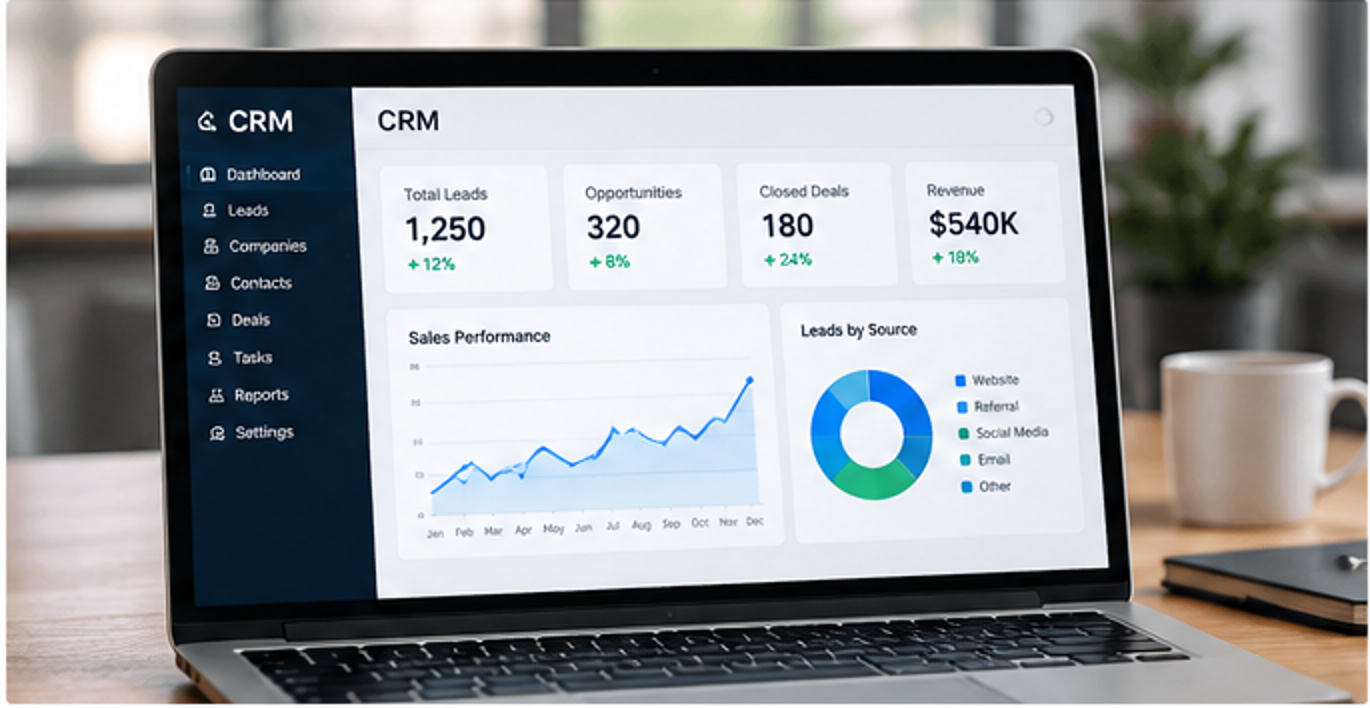
Customer relationship management (CRM) is no longer simply a digital address book. For software-as-a-service (SaaS) companies, it increasingly acts as the connective tissue between acquisition, onboarding, product usage, renewals, and expansion. The central question for 2025 was not how many features vendors could add. It was whether CRM systems could help teams recognize customer needs earlier and respond with less manual work.
1. AI moved closer to everyday sales work
One major prediction for 2025 was that artificial intelligence would become an embedded workflow assistant rather than a separate novelty. Practical applications include drafting follow-up emails, summarizing meeting notes, suggesting next actions, flagging potentially stalled deals, and routing incoming leads. A useful implementation starts with a narrow task and a measurable outcome: for example, reducing the time it takes a sales representative to prepare for an account review.
AI recommendations are only as dependable as the information supplied to them. Duplicate contacts, outdated opportunity stages, inconsistent product usage events, and vague consent settings undermine automation. Human review remains important for customer-facing claims, pricing commitments, and sensitive account decisions.
2. Customer data became a connected operating system
A SaaS business often stores valuable signals in several places: marketing automation, CRM, billing, customer support, and product analytics. A promising CRM strategy connects these systems around a clear customer and account record. That allows a customer success manager to see whether a renewal is approaching, whether usage has declined, and whether unresolved support issues should change the conversation.
Integration does not mean collecting everything indiscriminately. Teams need agreed definitions for accounts, users, lifecycle stages, ownership, and data retention. A smaller set of trustworthy fields can be more useful than an extensive profile nobody maintains.
3. Automation became more focused on lifecycle moments
Automating every message can create a poor customer experience. The more useful 2025 direction was event-driven automation: a welcome sequence after activation, a prompt when setup stalls, or an internal alert when an important account shows signs of disengagement. Automation should remove friction while leaving room for meaningful human attention.
A practical rule is to document the trigger, recipient, goal, suppression conditions, and owner for every automated workflow. Review performance regularly, especially unsubscribe rates, response quality, and whether the workflow actually changes customer outcomes.
4. Personalization needed to become more relevant, not more invasive
CRM platforms can tailor outreach by industry, account maturity, use case, and verified customer behavior. A growing SaaS customer may benefit from guidance about team adoption; a new trial user may need help reaching a first successful outcome. These are different situations and deserve different communications.
Responsible personalization uses data transparently and respects preferences. Companies should verify access rights, minimize unnecessary collection, and give people sensible ways to manage communications. Trust is part of the customer relationship, not merely a legal checkbox.
5. Predictive analytics had to prove its value
Lead scores and churn signals can be useful, but they are not objective truth. A prediction should be accompanied by understandable factors and tested against actual outcomes. If a churn model creates dozens of false alarms, customer success teams may stop using it. If a forecasting dashboard is not maintained, its polish will not make the projection credible.
Start with a baseline and a small set of outcomes: qualified-to-won conversion, onboarding completion, renewal rate, expansion revenue, and time spent on administrative work. Compare performance before and after implementing a new capability, and account for other business changes.
6. Simpler experiences mattered more than feature overload
As SaaS stacks expanded, usability became a competitive advantage. Teams needed intuitive account views, sensible defaults, mobile access where relevant, and integrations that did not require constant troubleshooting. A CRM that demands too much data entry encourages workarounds and weakens reporting.
Companies evaluating their stack should observe actual workflows: how quickly can a representative log a meaningful interaction, hand an account to customer success, or identify the next action? These details often reveal more than a product demonstration packed with features.
What SaaS leaders can learn from the 2025 outlook
The durable takeaway is that successful CRM modernization is an operational project, not simply a software purchase. Begin with a clearly defined customer journey, improve data quality, choose integrations that support that journey, and introduce AI only where it solves a real problem. Make privacy, employee training, and measurable outcomes part of the design from day one.
For smaller SaaS companies, a focused CRM with reliable billing and support connections may outperform a heavily customized enterprise deployment. Larger organizations may need stronger governance, flexible permissions, and multi-team reporting. In either case, the right next step is to identify one costly customer-facing bottleneck and improve it before attempting a platform-wide transformation.
Frequently asked questions
Did AI replace CRM administrators or sales professionals in 2025?
No. AI can support routine tasks and analysis, but workflow ownership, data stewardship, relationship building, and judgment still require people.
Which CRM metric should a SaaS company prioritize?
Choose a metric tied to the problem you are solving. Renewal rate may matter most for retention work, while activation or qualified pipeline conversion may be more useful for an early-stage growth initiative.
Should every SaaS company adopt predictive scoring?
Not necessarily. A business needs enough reliable historical data, a defined decision that the score will inform, and a way to measure whether it improves that decision.
Further reading
HubSpot: 2025 State of Sales · Pipedrive: State of Sales and Marketing 2025 · NIST: AI Risk Management Framework